
We Get "Conversed"
The Albina Vision Trust calls forth a batallion of bureaucrats. Some civilians also show up. Unreality ensues.

“If we study this progression in terms of the impact on the sensibilities of the participator as he moves through these spaces, the true nature of the design can be felt. Here are the joy of ascent and descent, the recession planes, and the penetration in depth. This is architecture that…cuts the sky in a never-ending series of undulating lines and curving shapes as the points in space move across one another in the view of the participator progressing up the central way.”
—Design of Cities by Edmund N. Bacon.

Bacon is the reigning guru of modern city planning, and the noxious breed of bureaucrats who feel it’s their duty, and right, to “plan” the bejabbers out of the spontaneity, animal spirits, and unpredictability of just about every town on the planet. Portland, most of all.
I was reminded of this when a friend and I decided to spend a warm summer evening over at Tubman Middle School to join a “conversation” about the future of the Albina neighborhood.
It was sponsored by a melange of the Usual Suspects: PBOT, Prosper Portland, the Bureau of Planning and Sustainability, and the Albina Vision Trust…
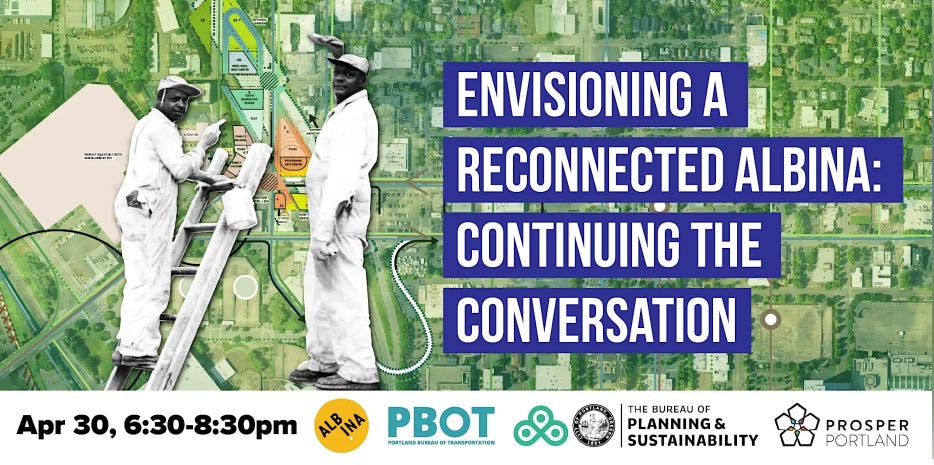
…the graphic continuing the, “it’s racist…but let’s keep it between us” motif that is central to the city’s patronage of a nonprofit that, as we’ll find out, is making one of the biggest real estate plays since the Pearl, one that’s far more audacious because it will pay no taxes on whatever it builds, 1 and will be the sole owner of whatever results. Sorta like an old Deep South company town.
Such a deal.
There are other dreary, hodge-podge neighborhoods in Portland—outer Powell springs to mind—but Albina is special. That’s because 70 years ago, it was a mixed and rather run-down neighborhood, a “ghetto,” where many of the city’s vanishingly small minority of black people lived.
Depending on which history you’re reading, it was either a mob-run enclave (Google “Tom Johnson”2) in a notoriously corrupt city, where the local boss—behind the scenes— was engineering the condemnation of black-owned properties for the benefit of the highway and arena builders. Or it was…
…a creative, affordable and safe neighborhood that birthed citywide tree-planting programs to gesture tenderness to our Japanese neighbors after their internment during World War II, created world-class public education models established for and by Black Portlanders, and was nationally recognized as a hotspot for jazz and soul music on the West Coast.
That last is from the Albina Vision Trust, which we have written about here, here, here, and here, and which has taken as its tax-free mission the recreation of that old neighborhood, long after civil rights laws and a general cultural shift did away with ghettos for any race or reason.
But rather than rebuild the old Albina’s modest, single-family houses, the Vision Trust says it’s engaged in “restorative redevelopment,” which to our ears is both a cue for white guilt, and a hint of real estate hyperbole—nothing looks as good as it does on architects’ drawings—and, boy, does the Trust have drawings!
And so, here we are at Tubman, our tickets in hand, going through the check-in process: the obligatory, “Hello! name tags (curiously, there are little stickers to attach if you don’t want your photo taken) and a log that asks for your name, URL, and phone number—off to someone’s database. The event didn’t draw in any of the top political types3, and I didn’t spot any of the Trust’s top honchos. But John Russell, the reclusive developer of Big Stuff downtown (he’s now in a nasty fight over the future of the “Black Cube” on Market St.), was spotted chatting before disappearing.
Inside the Tubman space, a glance around the stuffy hall hinted that bureaucrats from all of the city agencies and the Trust probably outnumbered actual drop-ins…
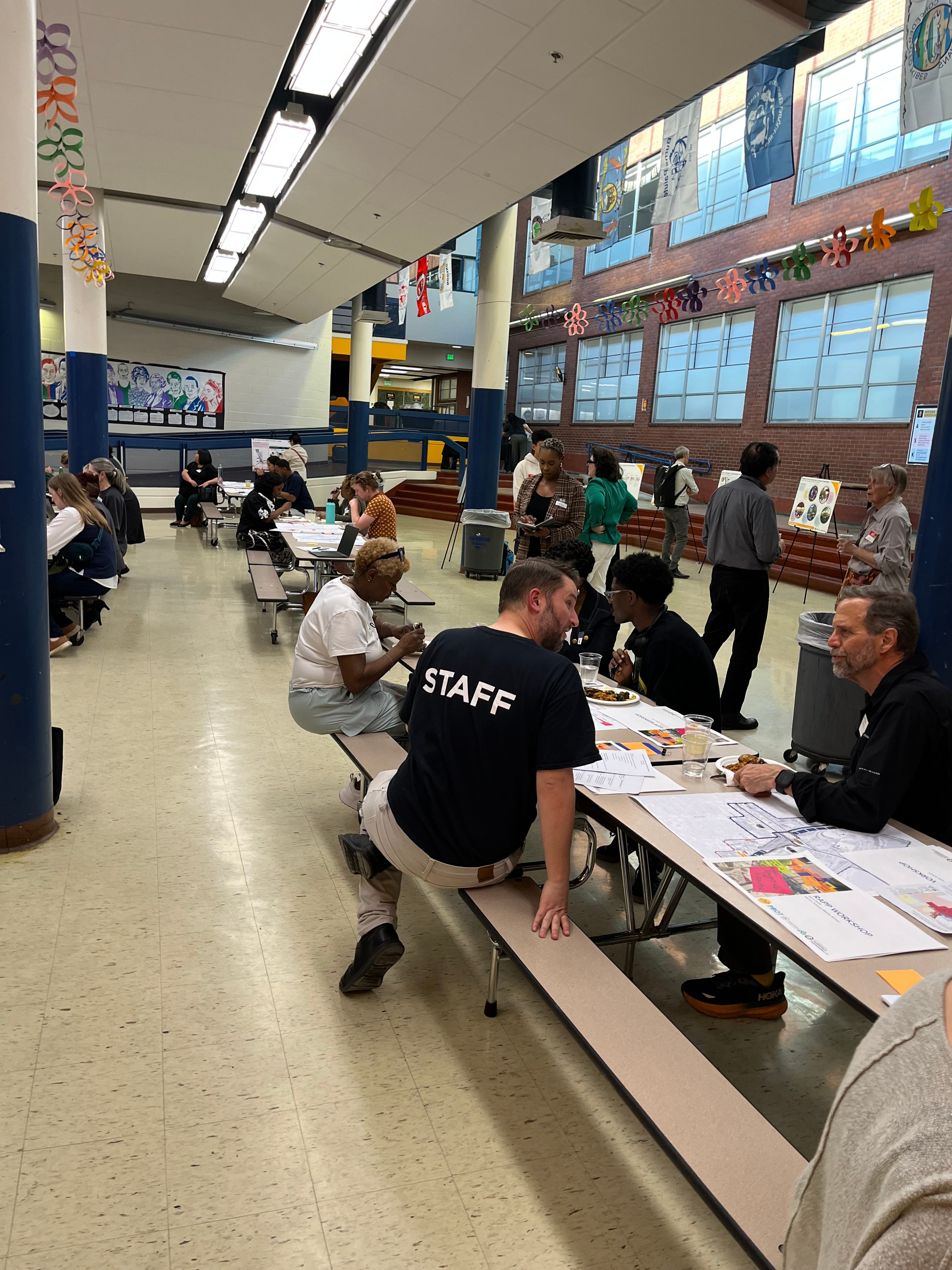
…and while I didn’t do a head count, attendance by self-selected conversers seemed a little light. It was, however, better than a Vision Trust “conversation” out on the east side last year which drew, finally, four participants including me and a pal.
The bureaucrats—hope they weren’t all on overtime—were easy to pick out. As a veteran of other listening/conversing exercises, the tells are: youth, smiles verging on insane, and eager eyes. When they mix with locals, their unctuousness (with a hint of condescension) gives you the willies. Which makes sense, because the evening’s first order of business was a full page of “community-centered agreements”—think of the “agreements” you have to tick or be tossed from a website. Key command: “… let’s stay grounded in the discussion...”
Which meant that this meeting would be “facilitated,” which meant that the “facilitators” would hold the whip-hand, which meant (as we soon found out) that there would be no questions about the size and shape of the project, such as: who’s going to pay for all this stuff? Who’s going to own it when the dust finally settles? What about the money!
Instead…it was imagination time!
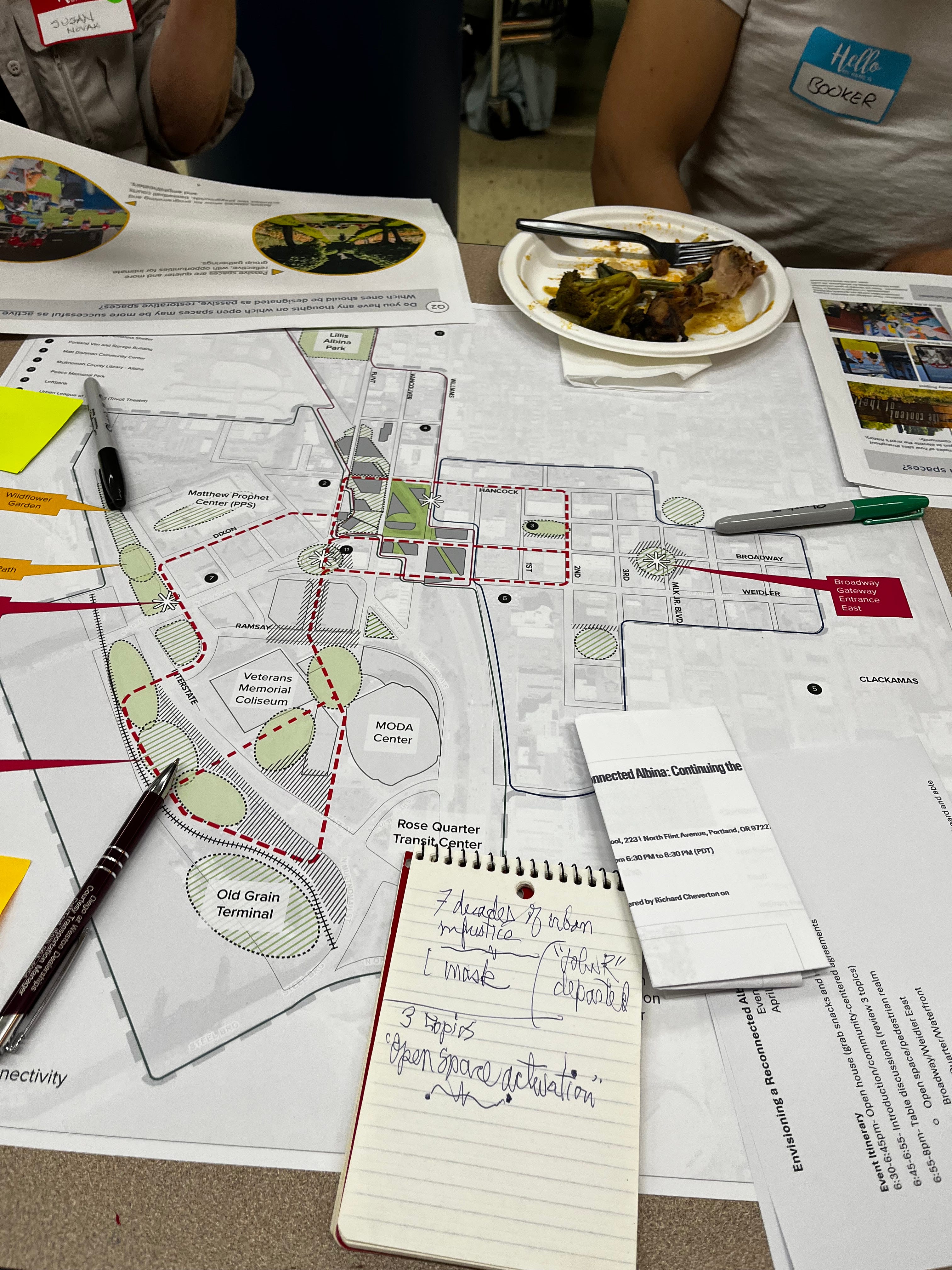
As it happened, the facilitator at our picnic table (where we labored through three topic-areas under rigorous time controls), was none other than Carly Harrison, the Trust’s senior vice president of real estate. We quickly got her facilitator powers sorted when I asked about a green spot on the map where the PPS’s Prophet Center now stands.
Before we get her response, some back-story :
The Center’s 340,000 square feet on 10.5-acres appeared under various guises (“passive open space,” or “close knit housing,” or “creating black heritage”), on the table-cloth-sized map on our table …
Back in 2024, the Portland Public Schools board did a deal with the Trust to swap the Center for another space elsewhere in the city, with the Vision Trust paying for the new center and the move. The Vision Trust said it had 14 sites ready to roll. The board would get the list by May—of last year.
Since then…omerta. I’ve regularly written Candice Grose (she/her), the PPS’s Chief of Communications, for updates. Her latest response (in March): “I’ve checked with our Chief of Staff. She informed me that this is still in the works, but nothing solidified yet. Best, Cg.”
I wrote her a day or so ago, knowing I’d be attending the Trust/city dog-n-pony show…but no response to my query. The new norm for emails to city staff.
Back to the meeting. Ms. Harrison’s response was diplomatic but firm: you’re not…
…imagining.
And she gave me a look I can only guess was: I know what you know and I ain’t playing that game.
Ditto any discussion about another green smudge, unlabeled, in the middle of the map. It was, Ms. Harrison admitted, after some prodding, the cap.
Another disappearing act. Another back-story.
Back when Gov. Kotek was ramrodding—or so she thought—a massive bail-out of ODOT (and its union) through the legislature by blowing out gas taxes, buried in the bill was $250-million for a concrete “cap” over the I-5 crush. This was a consolation prize for a $450-million federal pork barrel fund for the cap, which, for complicated political reasons, evaporated between DC and here. In the final, hectic power play over the ODOT bailout—surely you’ve voted against the gas tax on the primary ballot?—the cap disappeared.
That’s probably because the best ODOT estimate was that it would cost over $2-billion to construct the thing. And we all know what happens to ODOT cost-estimates. Lost in the fine print was that the structure could only support buildings up to three stories. Bye-bye high-rises. (Which, one might add, seems to be plunked down on the cap in Trust drawings.)
Thus Ms. Harrison’s observation: “That’s a long way off.” Of course, any follow-up questions wouldn’t fit the “imagination” template, but here goes:
Who says a government-funded cap is ticketed—no questions asked—for the Vision Trust? What will they do with it? Will they own it, lease it, sell to deep-pocketed guys like Mr. Russell to develop?
Who knows? If they do, they ain’t talking. That’s the nice thing about running a real estate development play as a nonprofit.
Then the conversation moved to Broadway and Weidler streets—surely some of the most treacherous in the city. The Albina project territory’s tail end protrudes down both of the two thoroughfares; anyone who’s taken those exits off the I-5 knows about their meandering lanes, the occasional trolly playing bumper-tag, and the profusion of drive-ins, fast food places, and a busy car wash along with some forlorn apartments.
This was not to be mentioned; instead the conversation centered on, “What would make NE Weidler feel more comfortable, liveable, and welcoming.” The imagining part got derailed when one of the bureaucrats muttered that Weidler, in particular, would be “quieted.” It will lose a lane.
PBOT’s latest, most persistent war on the automobile. “Quieted” (ie, jammed) traffic. Which will be (a) diverted into the bosky new housing blocks or (b) full of swearing, gridlocked drivers who will glare at the Millennials casually sitting in sidewalk cafes sipping lattes. (On property owned by those drug stores and eateries, who may not want to surrender their parking lots.) I actually braved the “agreements” to ask what would happen if there was resistance to giving up their frontages; the facilitator muttered, “zoning,” darkly.
Well, look at it philosophically: maybe Weidler will lose one of PBOT’s new “cram two lanes into one and let the dumb drivers figure out who goes first” intersections. Note: PBOT just repainted and “calmed” one of my neighborhood intersections with soon-to-be-calmed 82d St., and I have missed being sideswiped a couple of times by typical Portland drivers who solve every traffic issue by…
flooring it…
…through this kamakazi bit of traffic engineering.
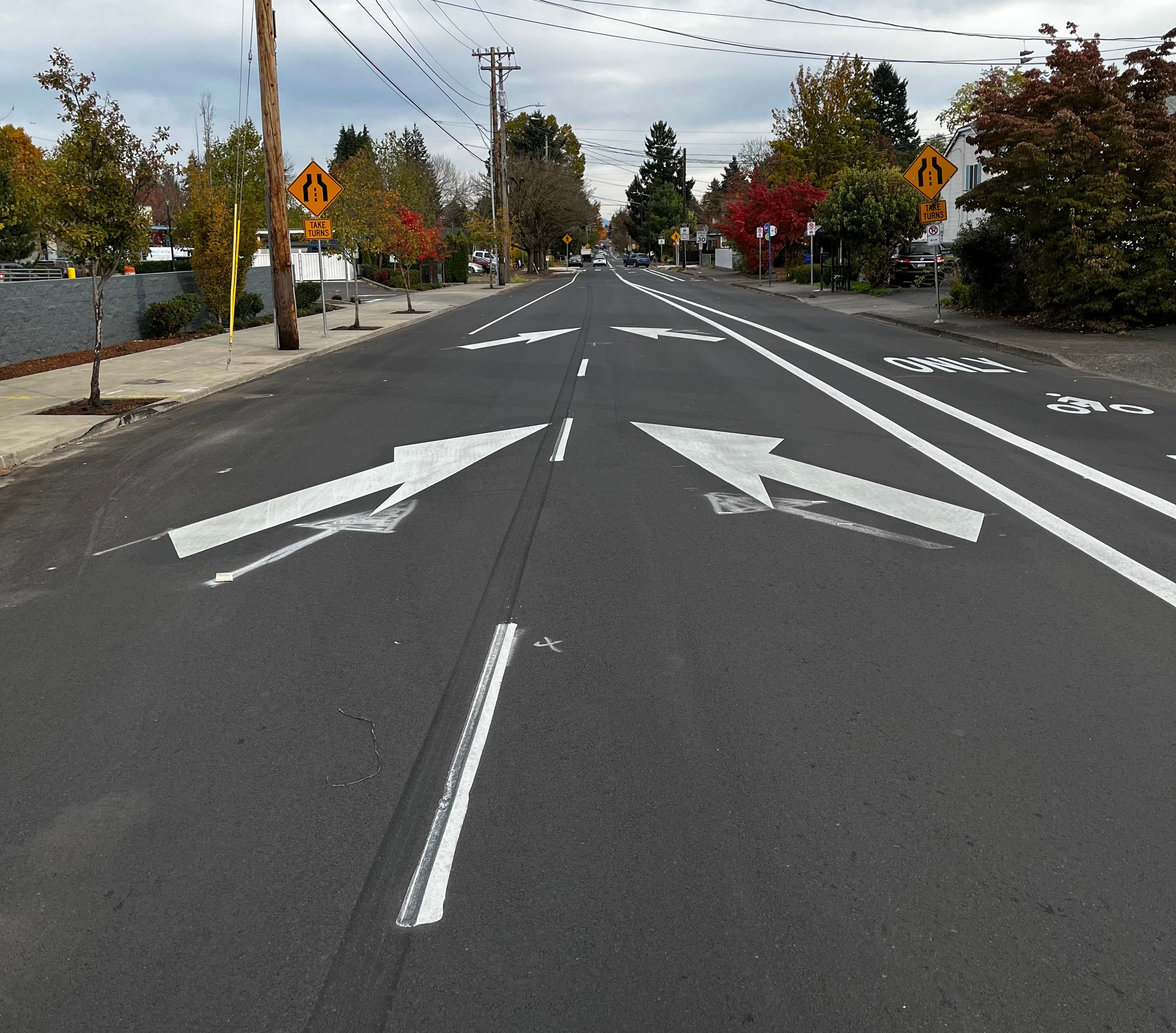
There were a few moans about the calming—not enough to trigger any “community-centered agreements”—but just about every Portland citizen knows that PBOT is beyond appeal to reason, or any law, and thus remonstrance is useless.
So, it left the picnic table’s five walk-ins, plus three attending bureaucrats, to use their imagination!!! on the third topic: the Rose Quarter, home of the Blazers (until the Dallas auto loan magnate gets a better offer)4. Having been through a few of these “conversations,” I was not surprised that imaginations soon veered out of control.
One panelist said we should look like Sienna, Italy, or Montreal or maybe like Paley Plaza in New York; while another boomed on about how the railroad’s main freight line smack-dab through the waterfront park should be buried and food carts could be installed in the Moda parking lot, and…and…and…while another mused that she’d like to be able to watch the sunset from the promised riverfront park, mindless that a mountain and city skyscrapers might interrupt the show.
My final act of imagination was to suggest making the park into a Grand Prix racetrack. The facilitator gave me a look, and ordered the silent note-taker to write that down. I also suggested that it would be really nice to put a really tall statue in the middle of the cap, since it’s a bona fide “gateway opportunity.” I knew Abe Lincoln would be a loser, but I couldn’t think of what would fly.
It was only later, over a mug of Ayinger Celebrator Doppelbock at Stammtisch, that I realized who should be memorialized.
Tom Johnson.
Typical of 501-c-3 nonprofits, the Vision Trust discloses only what is required on the annual IRS form 990…which isn’t much, and which usually takes over a year to be made public. A recent Supreme Court case, First Choice Women’s Resource Centers Inc., strengthened restrictions on the disclosure of donors.
For the best account, warts ‘n’ all, read Phil Stanford’s Portland Confidential. Worth every penny.
Most notably, Loretta Smith, who bludgeoned the city council into giving $8.5-million to 26 people who may (or may not) have lived in Albina decades ago and who claimed they were deprived of “generational wealth,” even though the properties involved were bought legally by the city government at fair market prices. As we wrote here, and here.
Subprime loans are getting twitchy, so Mr. Dundon may be pulling in his horns, but he’s known for seeing his hockey franchise back east as the linchpin for big surrounding development, which is the rage among sports-team owners. Which makes one wonder if he will use the Blazers fungibility to muscle the Trust out of some nearby development opportunities. After all, the Trust hasn’t actually bought anything, other than a run-down apartment building, next to which they built a tax-free, government-supported public housing project. Talk is free; construction loans not so much.
I asked an associate for their take on the Albina Vision Trust project:
-------------------------------------------------------------------------------------
What the Albina Vision Trust is attempting, if its drawings reflect its actual ambitions, is one of the most audacious urban real estate plays in Portland's history — more so than the Pearl, as Cheverton notes, because the Pearl involved private capital taking private risk on privately acquired land. The Trust is attempting to assemble a neighborhood-scale land position using public subsidies, government partnerships, tax exemptions, and philanthropic capital, while maintaining the governance opacity of a private nonprofit.
The "restorative redevelopment" framing is doing enormous ideological work — it makes scrutiny of the financial structure feel like an attack on racial justice, which is precisely why the imagination exercise format is deployed rather than genuine public accountability sessions. The history of black displacement from Albina is real and documented. Its deployment as a shield against financial transparency is something else entirely.
Cheverton's instinct that this resembles a company town is financially sound. The question of who benefits — the community the Trust claims to serve, or the Trust itself and its development partners — cannot be answered from the outside with the disclosure currently available. That opacity is not accidental. It is, as with the Multnomah County's homeless services screening tool, [1] a feature rather than a bug.
[1] De Dios, Austin. "DOJ official threatens investigation into Multnomah County homeless services over screening tool." The Oregonian/Oregon Live. 1 May 2026. https://www.oregonlive.com/politics/2026/05/doj-official-threatens-investigation-into-multnomah-county-homeless-services-over-screening-tool.html
You are far too entertaining to remain in that outhouse-in-a-tornado they call Portland. Save yourself. Get out.